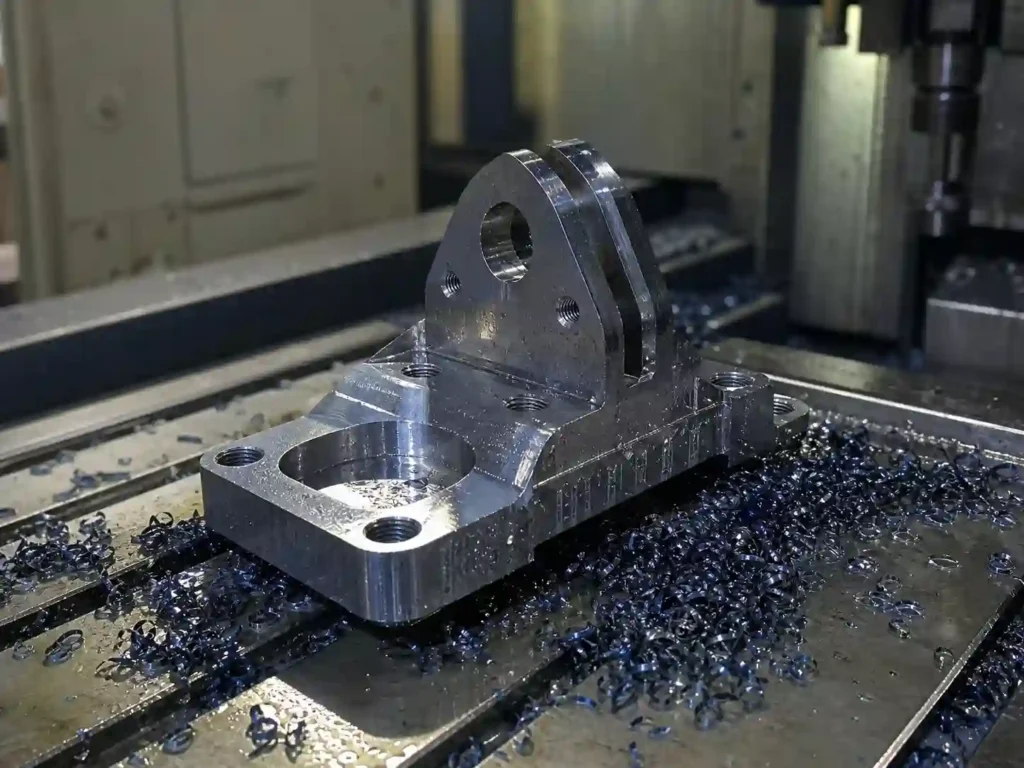
A capable Vietnam machine shop delivers precision-machined components: CNC milled, turned, fabricated, or cast to specifications that match North American and European OEM standards, while operating at lower landed cost than US-based suppliers and with less geopolitical exposure than China-only sourcing. The right partner pairs technical capability with ISO 9001:2015 quality systems, transparent communication in English, and proven export logistics. The wrong one quietly costs more than it saves.
This guide is written for procurement managers, sourcing engineers, and OEM buyers who already know they want to engage a manufacturer in Vietnam, but need a clear way to evaluate which shop is actually capable of delivering. We will cover what a Vietnam machine shop should offer, how to qualify one before sending an RFQ, what real cost looks like beyond the unit price, and where projects most often go wrong.
What Is a Vietnam Machine Shop, and Why Buyers Are Looking
A Vietnam machine shop is a precision manufacturing facility, typically located in industrial zones near Ho Chi Minh City, Hanoi, or Da Nang that produces machined metal parts and assemblies for export. These shops range from small job shops with a handful of CNC mills to fully integrated contract manufacturers offering CNC machining, sheet metal fabrication, casting, forging, welding, surface treatment, and assembly under one roof.
Demand has grown sharply over the last decade. According to the World Bank, Vietnam’s manufacturing and processing sector has been one of the country’s fastest-growing economic drivers, supported by sustained foreign direct investment in the industrial supply base (Source: World Bank, Vietnam Country Overview, 2024). For US and European OEMs, the country has shifted from a “low-cost alternative” to a strategic second source.
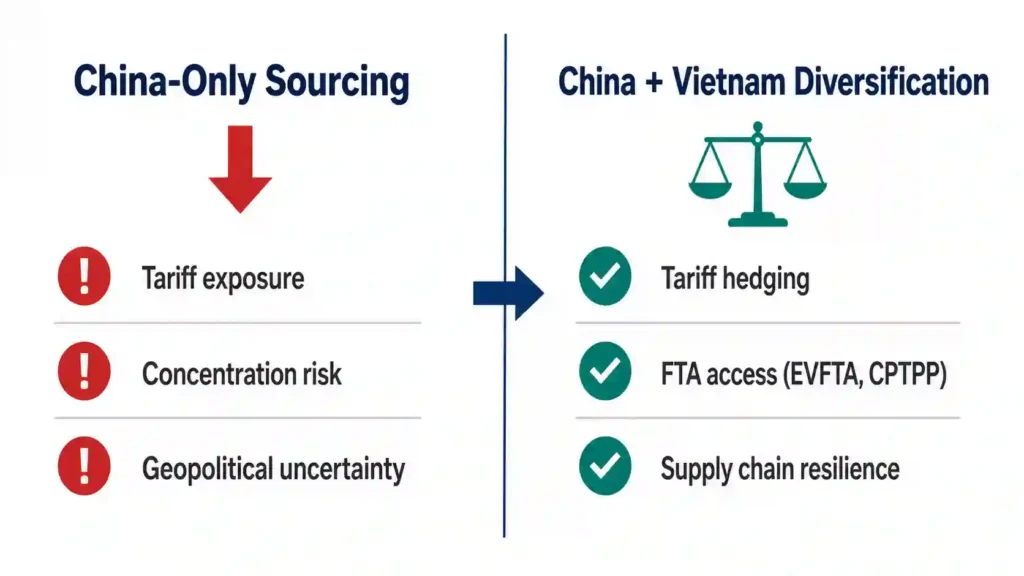
The shift from China-only to “China + Vietnam” sourcing
Three forces drive the trend. First, tariffs and trade policy uncertainty between the US and China have pushed buyers to diversify. Second, Vietnam’s free trade agreements including the EVFTA with the European Union and the CPTPP, give exports preferential access to major markets. Third, the country’s industrial workforce has matured: trade schools, technical universities, and decades of FDI from Japanese, Korean, and Taiwanese OEMs have built a base of skilled CNC operators, welders, and quality engineers.
The result is that “Vietnam” no longer means “cheaper but riskier.” For the right product categories and the right shop, it means competitive cost, comparable quality, and a more stable trade relationship.
What buyers typically outsource to Vietnam
The strongest fit between Vietnam machine shops and Western buyers is in mid-volume, mid-complexity precision parts, the kind of work that sits awkwardly between a US prototype shop and a high-volume Asian commodity supplier. Common categories include:
- Machined components for railroad, transit, and freight equipment
- Structural and welded assemblies for mining, construction, and material handling
- Off-road and commercial vehicle parts
- Castings and forgings for heavy industrial OEMs
- Sheet metal fabrications and enclosures for industrial machinery
This is exactly the category Trans Machine Technologies Vietnam (TMTV) was built to serve.
What a Capable Vietnam Machine Shop Should Offer
Not every facility that calls itself a machine shop can support an export OEM program. Use the following capability checklist when shortlisting suppliers.
Core machining capabilities
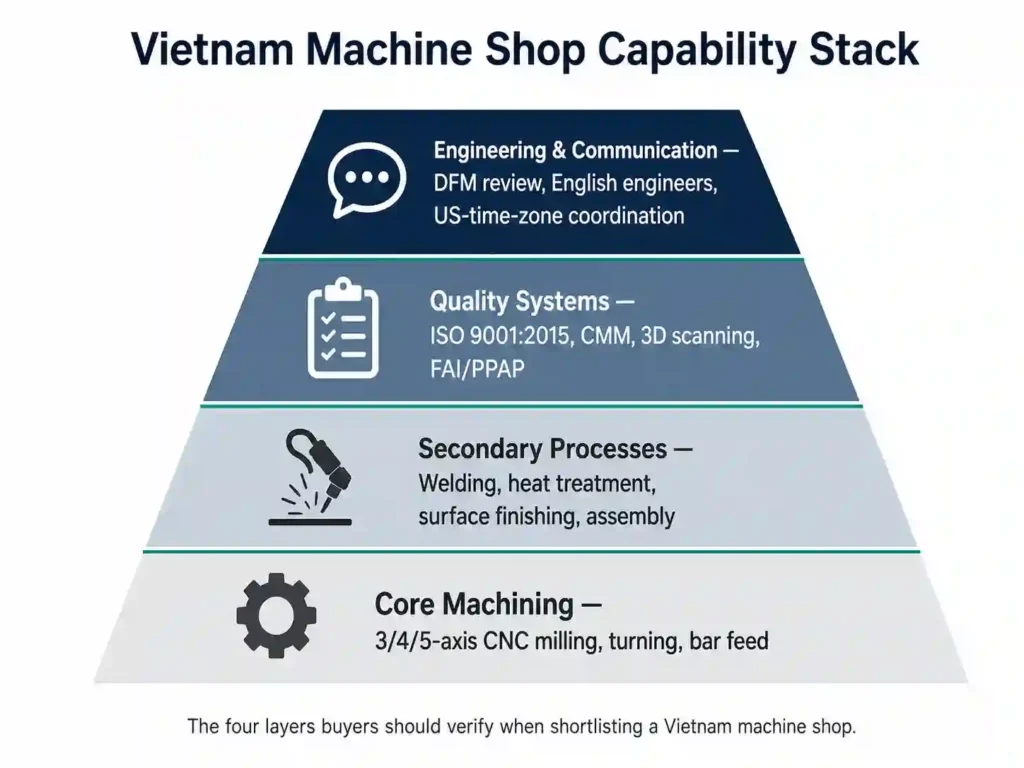
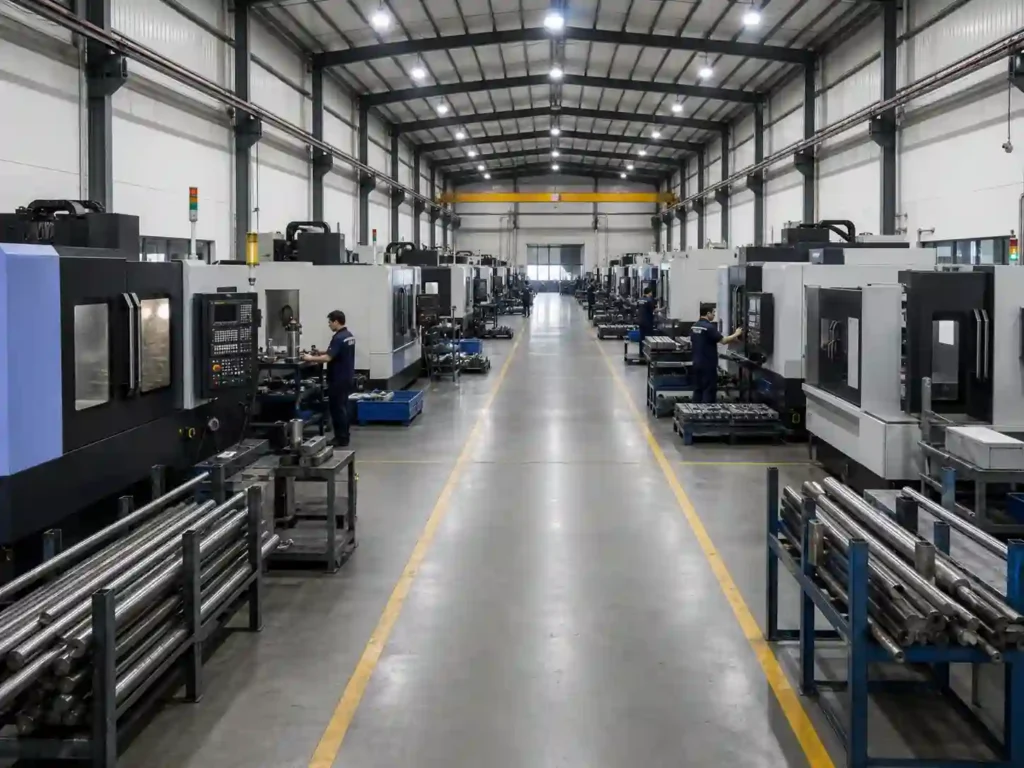
A serious Vietnam machine shop should operate, at minimum, a fleet of 3-axis CNC milling centers and CNC turning centers, with at least some 4- or 5-axis capability for complex geometries. Bar feeders, live tooling, and Y-axis lathes signal that the shop can run production parts efficiently rather than handling everything as one-off prototypes.
Beyond machine count, look at brand quality and maintenance discipline. Doosan, Mori Seiki, Hwacheon, Mazak, and DMG MORI are common indicators of a shop that has invested in equipment durable enough for production tolerances over years, not months. Trans Machine Technologies Vietnam’s facility, for example, runs more than 17 CNC machines including Doosan NHP6300 and NHP5000 horizontal machining centers, Hwacheon VESTA-1000 mills, Mori Seiki SL 25 lathes, and Doosan Lynx 2100LSY live-tool lathes with bar feed.
Secondary processes and assembly
Most OEM parts need more than machining. A capable shop offers – or tightly manages – heat treatment, surface finishing (shot blasting, painting, powder coating, plating), welding (MIG, TIG, robotic), and mechanical assembly. The advantage of doing these in-house or through a controlled local network is shorter lead times and one accountable point of contact for quality issues.
Quality systems and inspection
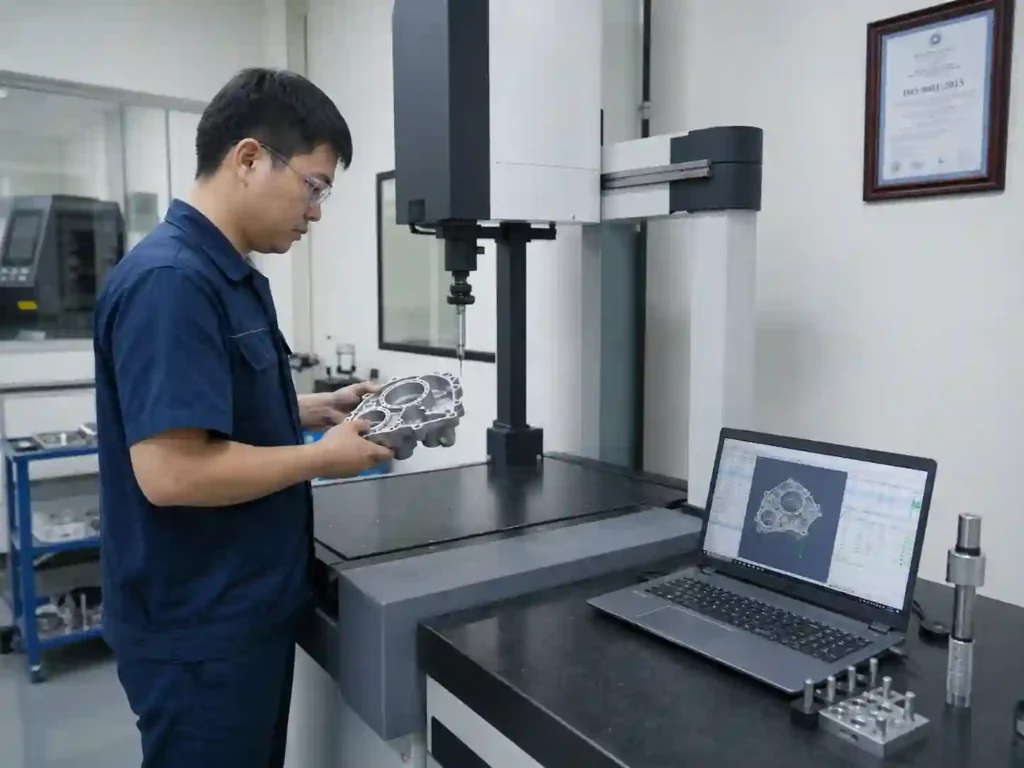
Quality is where Vietnam machine shops separate. The minimum bar for export work is ISO 9001:2015 certification with current scope and a real audit trail. Above that, ask whether the shop runs:
- A coordinate measuring machine (CMM) for dimensional verification
- 3D scanning for complex or first-article inspection
- PPAP, FAI, or APQP documentation on request
- In-process inspection with documented frequency
- Material traceability from incoming inspection to shipment
If a shop cannot describe its inspection process in concrete terms, it does not have one.
How to Evaluate a Vietnam Machine Shop Before Sending an RFQ
Before any pricing conversation, run a structured qualification. Treating the first contact as a sales call wastes everyone’s time; treating it as a technical interview separates capable shops from order-takers.
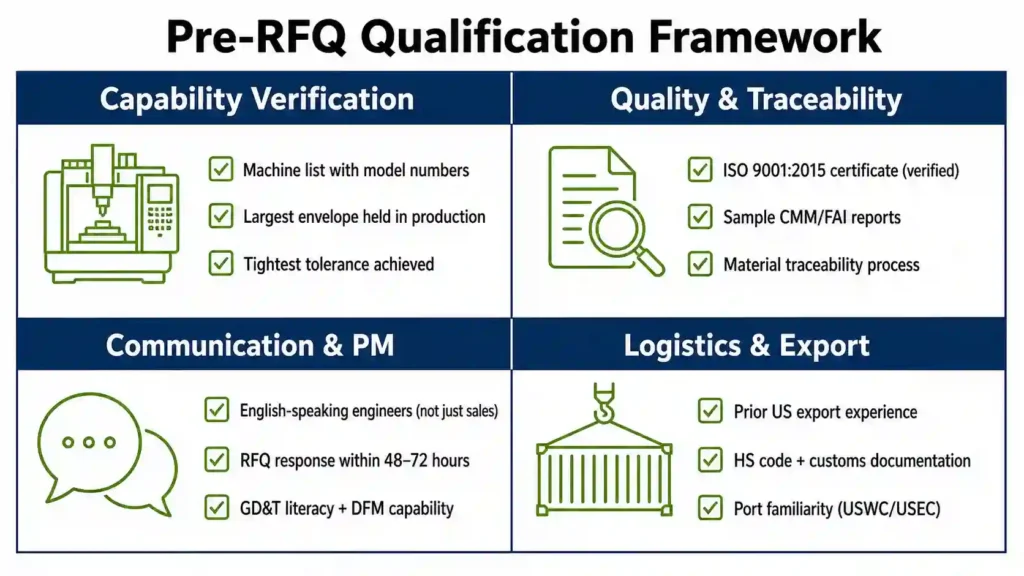
Capability verification
Ask for a machine list with model numbers, axis configurations, and table sizes. Ask for the largest envelope and the tightest tolerance the shop has held in production. Ask which materials are run regularly stainless steel, alloy steel, aluminum, ductile iron, brass and which require external sourcing. The answers tell you whether your part fits inside the shop’s comfort zone or sits at its edge.
Quality and traceability
Request the ISO 9001:2015 certificate and verify the certification body and expiry. Ask for sample inspection reports, FAI documentation from a recent project, and the shop’s non-conformance procedure. A shop that cannot show you a real CMM report on request is not running a real quality system.
Communication and project management
This is where many Vietnam shops lose Western buyers. The right partner has English-speaking engineers not just sales staff who can read GD&T, run a DFM review, respond to RFQs within 48–72 hours, and escalate problems early rather than hiding them. Time zone overlap matters: a shop with US-side coordination (or a US office) closes the gap that a 12-hour difference otherwise creates.
Logistics and export readiness
Confirm the shop’s experience with export packaging, HS code classification, and documentation for US customs. Ask whether they have shipped to your country before, and to which ports. A shop that has never managed a US ocean freight shipment will learn on your project and you will pay for the learning curve.
Cost Reality: What “Vietnam Pricing” Actually Reflects
The headline reason buyers look at Vietnam is unit cost. The real picture is more nuanced.
Labor is meaningfully lower than in the US and modestly lower than in coastal China. According to the International Labour Organization, average manufacturing wages in Vietnam remain well below those of higher-cost regional peers, which feeds directly into the labor-content portion of any quote (Source: ILO, Vietnam Labour Market Update, 2023). Material costs, however, often track regional benchmarks because much of the steel, aluminum, and alloy stock is imported.
A realistic Vietnam machine shop quote breaks down roughly as: labor cost, machine cost (depreciation and energy), general overhead, consumable and tooling cost, and profit. When buyers compare a Vietnam quote to a US quote, the labor and overhead lines compress; the machine and material lines do not move much. That is why simple parts with high labor content benefit most, while highly automated, low-labor parts may show smaller savings.
Then there is total landed cost. Ocean freight, customs, duty, packaging, and the cost of managing a longer supply chain all need to sit in the comparison. A part that is 35% cheaper at the factory gate may be 20% cheaper landed still worthwhile, but a different number than the quote suggests.
Common Risks When Working With a Vietnam Machine Shop
The honest list, from a partner who works in this market every day:
- Capacity overcommitment. Smaller shops accept more work than they can run on time, then quietly slip schedules. Ask for current capacity utilization and a realistic lead time, not the marketing answer.
- Hidden subcontracting. A shop without a particular capability may quietly send your part out without telling you. This affects quality control and IP. Ask explicitly which operations stay in-house.
- Documentation gaps. Inspection happens, but the paperwork is informal. For regulated industries railroad, defense, medical this is a deal-breaker.
- Communication friction. Sales speaks English; the shop floor does not. Engineering changes get lost in translation.
- Logistics surprises. Shipping documents arrive late, cargo misses cutoff, and the program slips a week.
The shops that have figured these out are the ones worth working with. The rest are still learning on someone else’s program.
TMT’s Approach as a Vietnam Machine Shop
Trans Machine Technologies operates as a US-headquartered industrial partner with manufacturing executed at Trans Machine Technologies Vietnam’s 2,500-square-meter facility in Nhon Trach III Industrial Park, Phase 2, Dong Nai. The structure is deliberate: the US team in Winston-Salem, North Carolina, handles customer coordination, sourcing communication, packaging planning, and import logistics, while the Vietnam team executes manufacturing at scale. Buyers get one accountable point of contact in their time zone and a fully equipped factory delivering the work.
The capability stack covers four production routes precision CNC machining, metal fabrication and welding, casting, and forging supported by 17+ CNC machines, MIG/TIG and robotic welding, sand casting, high-pressure and gravity die casting, and a forging line with a 1,000 kg press, induction heating, and electric furnaces. Quality runs to ISO 9001:2015 certification (registration VN 1326-QC) with CMM, 3D scanning, leak testing, tensile testing, and documented in-process inspection. Engineering services include DFM review, casting and forging design support, prototype iteration, and APQP documentation when programs require it.
Since 1997, Trans Machine Technologies has executed more than 900 projects across railroad and freight, mining, construction equipment, commercial vehicle and off-road transportation, agriculture, and broader OEM markets. The product mix today is roughly 60% CNC components, 20% sheet metal fabrication, 10% forging, and 10% casting which means a buyer evaluating TMT is evaluating a real production shop, not a brokered network.
FAQ
Is Vietnam a good country for CNC machining? Yes, for mid-volume precision parts in industrial categories. Vietnam offers competitive labor cost, ISO-certified shops, free trade agreement access to the US and EU, and a maturing engineering workforce. The fit is strongest for railroad, mining, off-road, and OEM industrial parts where precision matters but volumes do not justify full automation.
How does a Vietnam machine shop compare in price to China? Vietnam unit prices are generally close to coastal China for similar parts, sometimes slightly higher, sometimes lower. The real difference is often in tariff exposure, supply chain risk, and time to RFQ response. Many US buyers now run Vietnam as a primary or secondary source specifically to reduce concentration risk in China.
What certifications should a Vietnam machine shop have? ISO 9001:2015 is the baseline. Shops serving automotive should hold IATF 16949. Aerospace work requires AS9100. For railroad components, expect customer-specific approvals such as AAR M-1003. Always verify the certificate number, scope, and current expiry directly with the certification body.
How long does it take to get parts from a Vietnam machine shop to the US? Production lead time typically runs 3–6 weeks depending on complexity, plus ocean freight transit. According to Freightos shipping data, full container load (FCL) ocean freight from Ho Chi Minh City to US West Coast ports such as Los Angeles and Long Beach typically takes 20–30 days. East Coast ports such as New York, Savannah, and Houston typically take 30–40 days due to Panama Canal routing.
According to Shipa Freight transit benchmarks. Air freight is available for urgent shipments at significantly higher cost, with transit times of 2–6 days including customs clearance. Plan total lead time of 8–12 weeks for first orders to allow buffer for customs clearance, inland US trucking, and any first-article inspection cycles.
How do I qualify a Vietnam machine shop without visiting the factory? Request the ISO certificate, a current machine list, recent FAI and CMM reports, references from existing US or EU customers, and a video walkthrough of the facility. A shop that responds quickly and concretely to all five is usually worth a deeper conversation. A shop that hedges on any of them is not.
Conclusion
Choosing a Vietnam machine shop is not about finding the lowest quote. It is about finding a partner whose capability, quality system, communication, and logistics match the standard your program needs to hold and whose business model is built around export work, not adapted to it. The shops that win long-term OEM relationships are the ones that treat manufacturing as engineering and engineering as communication.
Trans Machine Technologies has spent more than two decades building exactly that kind of operation: US coordination, Vietnam execution, ISO-certified quality, and a four-process capability stack covering CNC, fabrication, casting, and forging. Precise thinking, precise result.
If you are evaluating a Vietnam machine shop for an upcoming program, send us your drawings or RFQ our engineering team will return a DFM review and a transparent quote, not a brochure.