
CNC cost is more than unit price. This guide explains four hidden RFQ factors that can increase total machining cost, from tolerances and process planning to quality control and delivery.
CNC Cost: 4 Hidden Factors That Most Buyers Miss
When buyers compare CNC suppliers, they usually focus on two things first: unit price and lead time. Both matter, but neither tells the full story of CNC cost.
In many sourcing projects, the biggest cost problems appear long before production starts. They begin during RFQ review, when critical details are missed, underestimated, or left undefined. A quote may look competitive at first, but the total cost can rise later through rework, scrap, quality failures, delays, and logistics issues.
That is why experienced sourcing teams do not evaluate CNC cost by quotation alone. They evaluate the total cost of execution.
Why CNC Cost Is More Than Unit Price
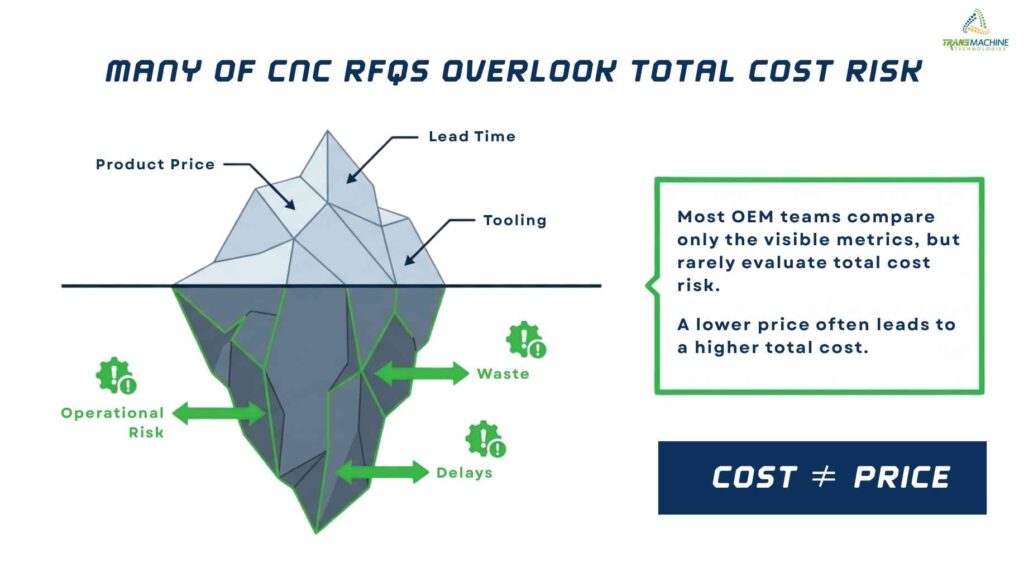
A low quote does not always mean a low total cost. In CNC sourcing, the initial unit price only reflects what the supplier included in the quotation. If key requirements were not fully reviewed, hidden costs often appear later.
Real CNC cost includes more than machining time. It is shaped by drawing interpretation, tolerance requirements, machining strategy, inspection scope, packaging method, and delivery conditions. When one of these areas is not aligned early, the project becomes more expensive and less predictable.
For buyers, the better question is not simply, “Who offered the lowest quote?” It is, “Who understood the project correctly from the beginning?”
Hidden CNC Cost #1 – Tolerance Misinterpretation
Tolerance review has a direct impact on CNC cost. A part may look simple on paper, but once geometric tolerances, critical fits, or surface finish requirements are involved, the manufacturing approach changes.
Tighter tolerances often require more precise setups, slower machining, better process control, and more inspection. If these requirements are not reviewed carefully during the RFQ stage, the quoted price may not reflect the real production cost.
In some cases, suppliers overestimate the requirement and apply unnecessary precision. This leads to over-machining, longer cycle times, and higher cost. In other cases, they underestimate the requirement and create quality risk, rejected parts, or expensive rework.
Tolerance is not just a drawing detail. It directly affects manufacturability, quality stability, and total CNC cost.
What buyers should clarify
Before approving a quote, buyers should confirm which dimensions are critical, which tolerances are functional, and which surfaces need special control. GD&T, surface finish, and inspection expectations should be reviewed before production begins.
Hidden CNC Cost #2 – Machining Process Assumption
Another common source of hidden CNC cost is incomplete process planning.
Two suppliers can quote the same part very differently because they are assuming different machining routes. One may review the full sequence of operations, setup requirements, tooling needs, and fixture strategy. Another may quote too quickly, based on simplified assumptions.
That difference matters. If the machining process is not reviewed properly, the quote may ignore secondary operations, extra setups, difficult tool access, or custom fixtures. The result is usually revised pricing, unstable lead time, or production problems after the order is placed.
A part is not priced accurately unless the machining route is understood accurately.
Common process issues that increase CNC cost
Some of the most common RFQ mistakes include assuming fewer setups than the part really needs, underestimating fixture complexity, using the wrong tooling strategy, or overlooking difficult features that slow production down.
Each of these issues may seem small on its own, but together they can significantly increase total cost.

Hidden CNC Cost #3 – Missing Quality Control Process
Quality control is not an optional extra. It is part of the real CNC cost.
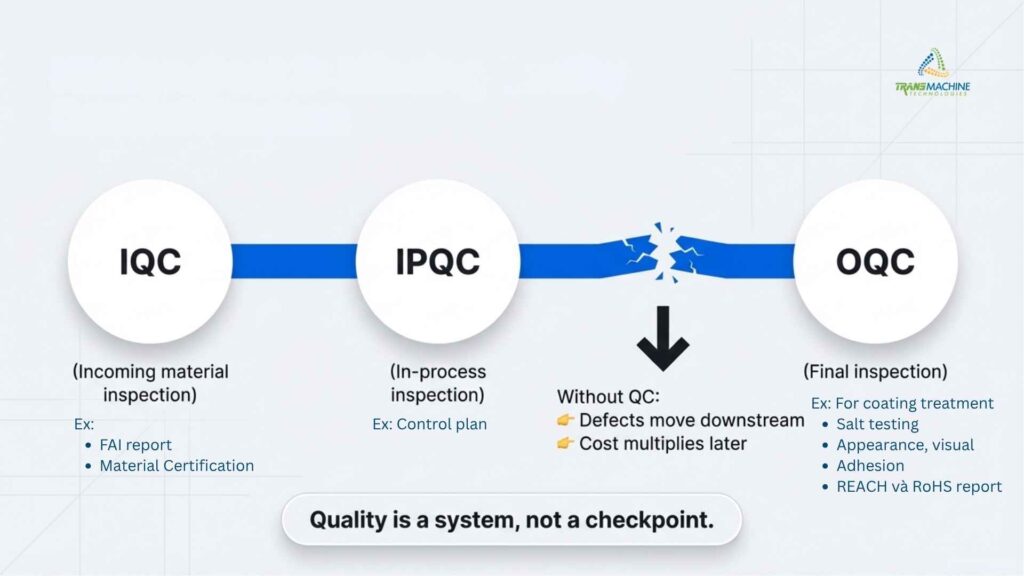
When inspection is not clearly defined from the beginning, defects are usually found too late. And the later a defect is detected, the more expensive it becomes. Hidden cost then shows up through scrap, rework, delayed shipment, repeated production, and customer complaints.
A robust manufacturing project normally includes three levels of control: incoming material inspection, in-process inspection, and final inspection before delivery. Without these checkpoints, the buyer may receive a lower quote at the start, but absorb much more risk later.
From a total-cost perspective, quality control protects cost rather than simply adding cost.
Hidden CNC Cost #4 – Packing and Delivery Uncertainty
Even when machining is correct, CNC cost can still increase unclear intercom term
This is one of the most overlooked areas in RFQ management. Buyers often focus on material, drawing, and lead time, but provide limited detail on packing method, export protection, carton or crate size, palletization, labeling, and Incoterms.
That lack of clarity creates hidden cost in several ways. Parts may be damaged in transit, freight cost may increase, shipments may be delayed, or export handling may become more complicated than expected.
In other words, logistics is part of the total product cost. If packaging and delivery are not defined early, the final CNC cost becomes less stable.
What should be aligned early
Before production starts, both sides should confirm packing standard, protective method, labeling requirements, shipping responsibility, and delivery terms. These details are operational, but they have a direct impact on cost, timing, and customer satisfaction.
How to Reduce CNC Cost Before Approving a Supplier
The best time to control CNC cost is before the order is placed.
A strong review should answer four key questions:
- Have the tolerances been fully reviewed?
- Is the machining process clearly defined?
- Are quality control steps included?
- Are packing and delivery requirements fully specified?
If any of these areas remain unclear, the quotation may not yet reflect the true cost of execution.

A Better Way to Evaluate CNC Cost
The most reliable suppliers are not always the cheapest on the first quote. They are the ones who combine technical understanding with execution discipline.
A better way to evaluate CNC cost is to look at four areas: drawing comprehension, process logic, quality structure, and logistics readiness. When these four elements are aligned early, the quote becomes more accurate, the project becomes more stable, and the total cost becomes easier to control.
In CNC sourcing, precision does not start at the machine. It starts with how the RFQ is reviewed.
Conclusion
The real cost of a CNC project is rarely hidden inside machining alone. It is usually hidden in the decisions made before production begins.
That is why CNC cost should not be judged only by unit price. Tolerance review, machining strategy, quality control planning, and delivery alignment all shape the final result.
A cheaper quote may look attractive on paper. A better-reviewed quote usually performs better in production.
FAQ section
What affects CNC cost the most?
CNC cost is influenced by part geometry, material, tolerance requirements, machining complexity, inspection scope, production volume, and delivery conditions.
Why does a low CNC quote sometimes lead to higher total cost?
Because some quotes do not fully account for tolerance review, machining process details, quality control, or logistics requirements. Those missing elements often create extra cost later.
Does tighter tolerance always increase CNC cost?
In most cases, yes. Tighter tolerances usually require more precise setups, slower cycle times, stricter inspection, and greater process control.
Is packaging part of CNC cost?
Yes. Packaging, export protection, labeling, palletization, and shipping terms can all affect total CNC cost, especially for international orders.
How can buyers reduce hidden CNC cost?
The best way is to review the RFQ carefully before approving the supplier. Drawings, tolerances, process flow, inspection scope, and delivery conditions should all be aligned early.
Need a clearer view of your true CNC cost before production starts? Work with Trans Machine technologies a manufacturing partner that reviews your RFQ beyond unit price and focuses on total execution cost.
